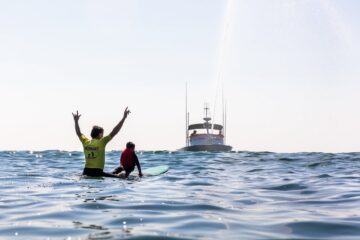
Teaching Life Through Surfing
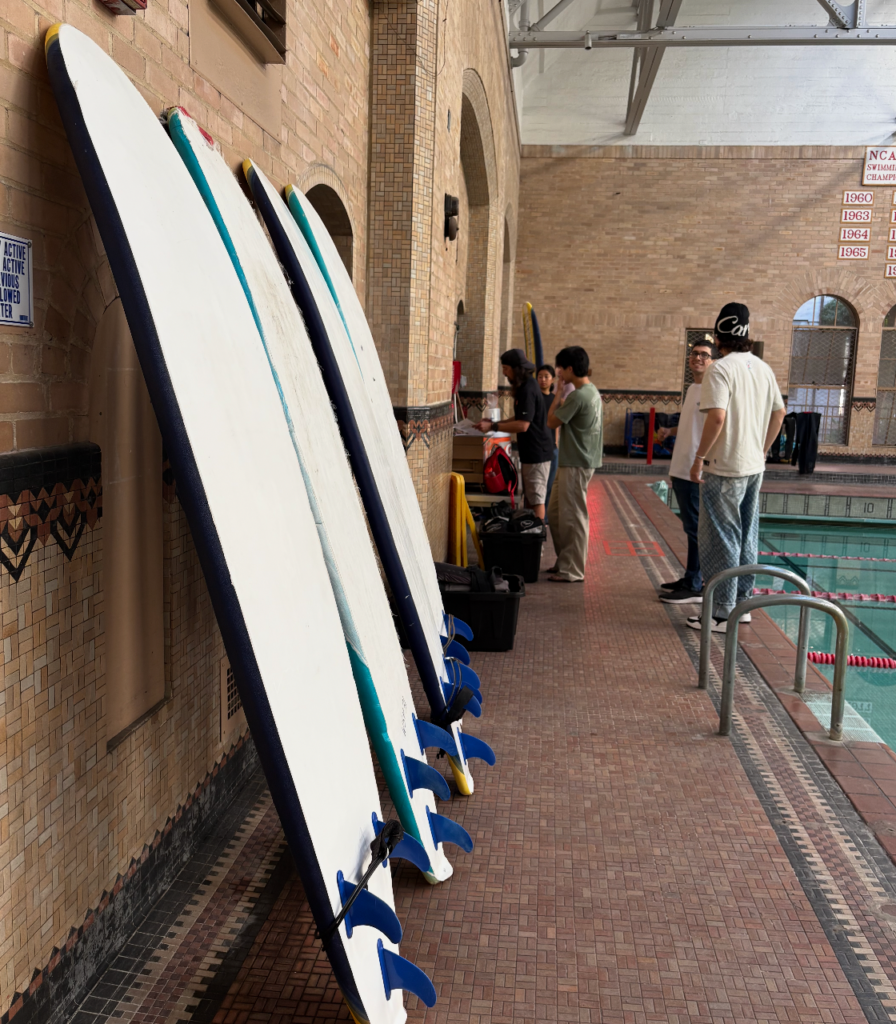
On a Monday morning in early December, Professor Ian Culbertson, or “Coach” as his students refer to him, is busy directing his students on how to return the surf boards and wet suits he loaned them for his surf class this semester.
Two students energetically walk up to him and hand him a bag of freshly baked cookies. “They’re still warm,” they let him know, as they walk out of the indoor pool area. Over the course of the next hour Coach hands out the cookies to all the people helping him organize the returned equipment, save one he enjoys later himself.
In between giving instructions on how to properly return loaned wet suits, he chats with students who tell him how they’re planning on continuing surfing and maybe even going out later today.
“He’s the man, bro, he’s really the best,” says Diego Dominguez, a student in Coach’s class. “He’s very supportive, he cares about his students, not just as surfers, but as individuals and in their lives.”
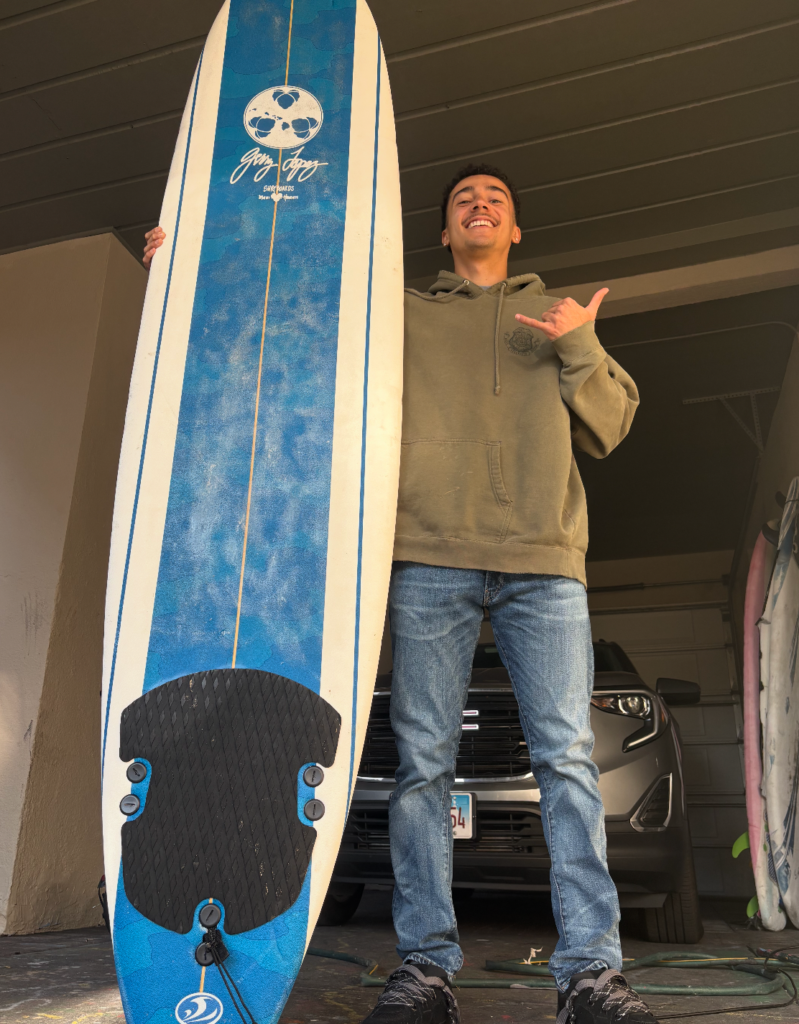
Dominguez poses with his surfboard he used for the semester
Coach has been teaching surfing now longer than he has surfed without teaching. He first started learning in middle school after seeing a flyer for a surf class. His mom thought it was too expensive and didn’t sign him up, but Culbertson wasn’t taking no for an answer.
“I decided, hey, I’m gonna save money and do it on my own,” he says. “Then I did that without telling her, and she freaked out.”
Coach laughs as he tells the story.
His commitment to learning to surf eventually convinced his mom to let him take lessons eventually. It wasn’t until he was a senior in high school that he finally knew when the waves would be best and really started improving as a surfer.
Surfing followed him to college at UC Santa Cruz. After enlisting in a recreational surf program at the school, he realized the teachers were doing very little teaching — and the TAs even less. Then began his quest to become a TA, a task that would become much more difficult than originally anticipated.
To become a TA, Coach first had to become lifeguard certified. In order to become lifeguard certified he had to become a stronger swimmer. So he enrolled in the lifeguard program’s teacher’s swim class for two quarters. Then Coach got his lifeguard certification and started working as a lifeguard.
Now, he was finally on the list to become a TA for the surf class, but there were plenty of people in front of him in the line, and he had to serve two quarters as a sub TA in order to be eligible for the full time position.
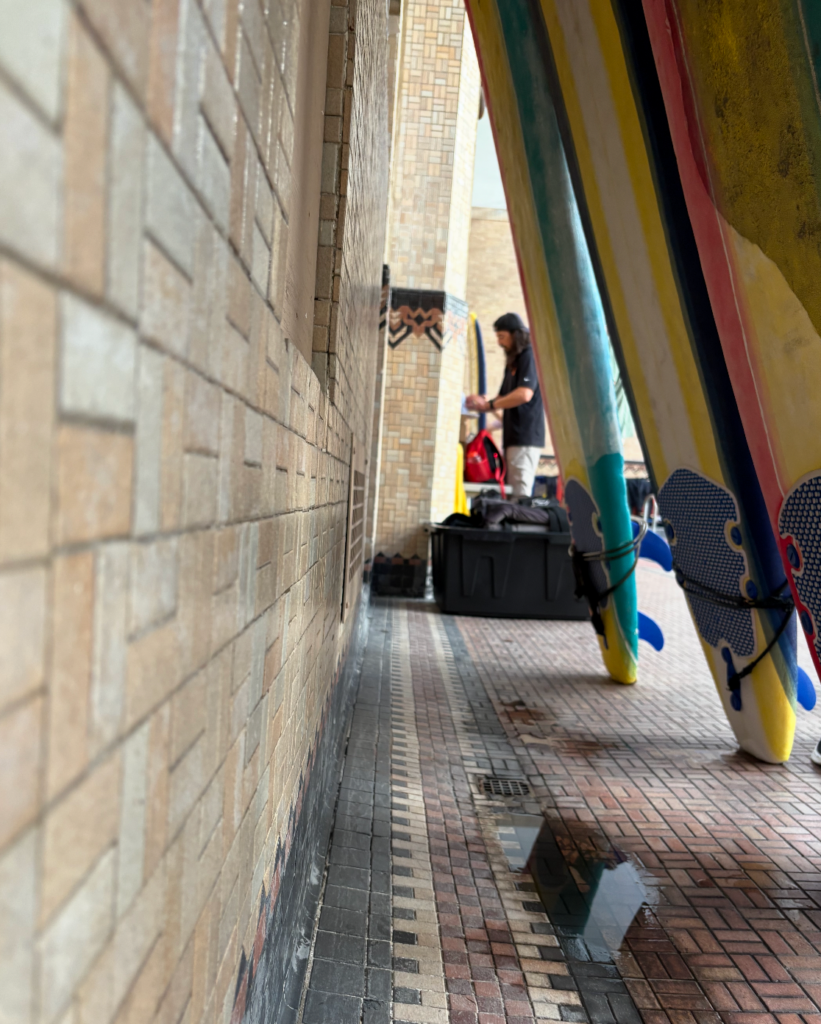
Ian Culbertson, surf teacher at USC, does paperwork as he finalizes his surf class for the semester
“I was waiting and waiting and waiting, and finally, one TA couldn’t do it one quarter. And I was next in line, I was the next dude on the totem pole. And I was like, yes!” Coach clenches his hand and pumps it in celebration, reliving the memory.
The teacher of the class just asked that the TAs be attentive in making sure all the students were safe. But Coach went a step further, also teaching surfing skills to students.
Not long after, the rec program was looking into adding more surf classes, but all the teachers were already maxed out, so they looked to the TAs. Coach was too humble to put his name in the hat but other instructors stepped up and said he should get the job, which he did.
All the while, Culbertson was still working as a lifeguard. Over the next few years, he worked his way up to become co-lead surf director of the program and co-instructor for the lifeguard classes. Then, Coach bounced around a bit, teaching a surf camp in Costa Rica, teaching at a few other schools, and then landing at USC, 13 years after teaching his first class at UC Santa Cruz.
Coach very much looks the part of a surf instructor with his long hair and backwards hat. “If you were to picture what a stereotypical surfer dude would look like, it would be him,” says Dominguez. “As soon as I saw him, I’m like, yeah, that dude has to be the surf professor. Sure enough, he was.”
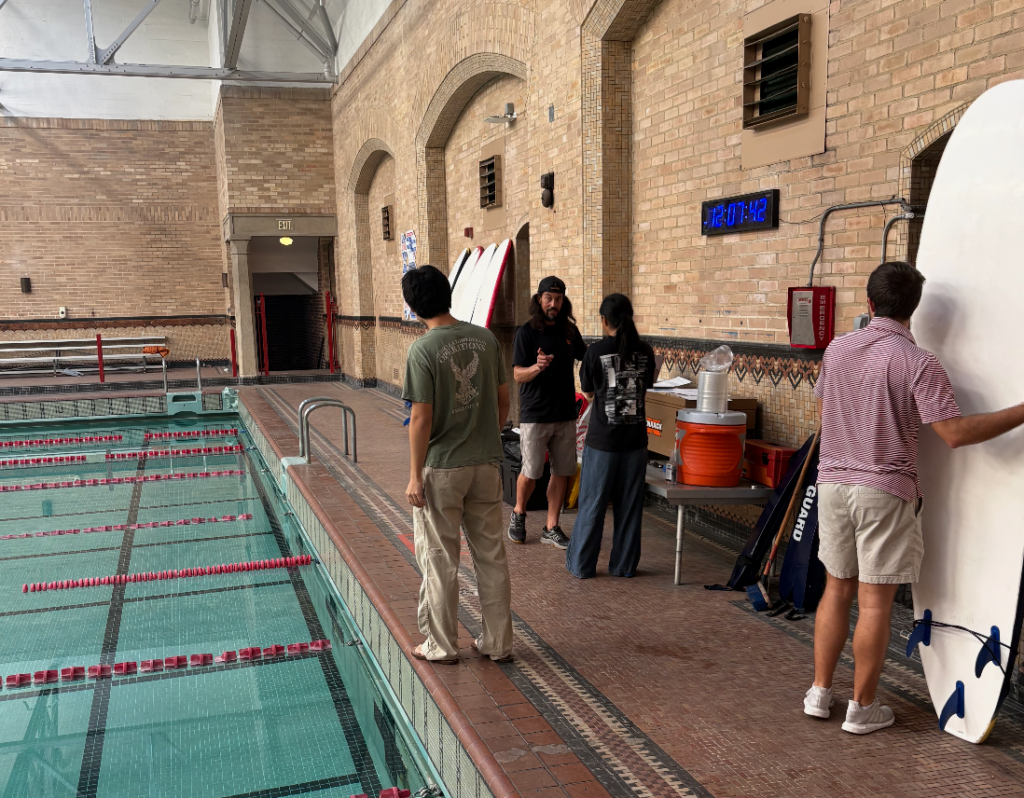
Coach talks with his students as they return their equipment
Coach is very inclusionary in his classes, and he mentions how cool it is to see the diversity of age, sex, and culture among his students.
At the beginning of all of his classes, he says, “I’m not here to teach you how to stand up.” He wants to turn his students into surfers. Not only how to catch waves, but also to teach them the background of surfing, and how they can use its lessons to get ahead in their love life, home life, and in their relationships with themselves.
“I want you, number one, to learn about the ocean,” Coach says to his students. “And number two, I want you to have fun in this class. And number three, I want you to do those things together and realize that surfing is an analogy for life.”
Just like how his students don’t always have great days at surfing, he wants to them to know they’re going to have days in their lives when things just don’t go their way.
“What did I take away from the class? It’s all about tenacity,” says Dominguez. “If you want to apply yourself, you can, just don’t give up.”
Coach’s favorite memories revolve around seeing students continue to surf after the class. Every semester, he holds a big surf trip for his current class and invites students from previous semesters to come out and join them, and every semester they do.
Coach has final conversations with his students at the conclusion of the semester
The last class in the water is consistently one of his favorites. He holds a competition where students can earn awards and points for different tricks they try to accomplish.
“It’s no longer just about trying to catch a wave. It’s about them trying to do something funny and weird to get points or get an award or whatever,” Coach explains. “And so they really are stepping outside their comfort zone and trying to push themselves a little more and do that.”
At the end of the day, Coach just wants to “share the stoke of surfing.”